
Introduction
Adhesive tapes are widely used in industries such as packaging, automotive, electronics, medical devices and construction. The adhesive tape manufacturing process often uses solvents in the coating, drying and lamination processes. These solvents can vaporize into the air, creating environmental problems, product loss and regulatory compliance challenges.
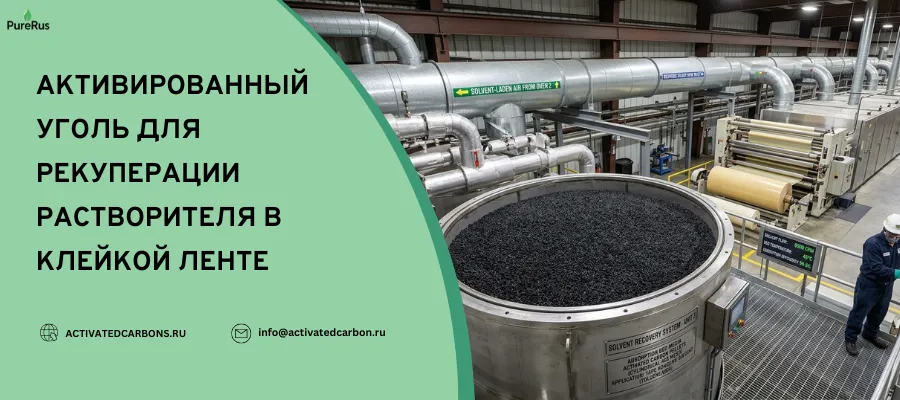
To address these challenges, many manufacturers use activated carbon for solvent recovery. This highly effective adsorbent material captures solvent vapors from the adhesive tape manufacturing process and provides recovery, reuse and safer emission control.
At PureRus Carbon, we offer activated carbon solutions designed to support industrial air purification and solvent recovery. In this article we explain how activated carbon works in the adhesive tape industry, its benefits and why it is an essential part of modern production systems.
Why solvent recovery is important in the production of adhesive tapes
In the adhesive tape industry, solvents are typically used in:
Formulation of adhesive formulations
Coating processes
Drying tunnels
Laminating operations
Surface treatment systems
These solvents may include hydrocarbons, ketones, esters, alcohols, and other volatile organic compounds (VOCs). If not properly controlled, they can lead to:
Air pollution
Health and safety risks
Product losses
Increase in operating costs
Compliance issues
Solvent recovery systems help capture these vapors before they are released into the atmosphere, reducing waste and increasing production efficiency.
How activated carbon works in the solvent recovery process
Activated carbon is a porous adsorption material with a very large internal surface area. When solvent-saturated air passes through a layer of activated carbon, the solvent molecules are trapped on the surface of the carbon.
This adsorption process allows manufacturers to:
Effectively capture solvent vapors
Regenerate valuable chemicals
Reduce emissions of volatile organic compounds (VOCs)
Improve air quality in the workplace
In many systems, the saturated activated carbon can be subsequently regenerated by steam, hot gas, or other desorption methods, allowing the regenerated solvents to be collected and reused.
Advantages of using activated carbon in the production of adhesive tapes
- Efficient solvent absorption
Activated carbon is capable of adsorbing a wide range of organic solvents, making it highly effective in adhesive tape manufacturing applications. - Cost savings due to recuperation
Recovered solvents can often be reused in manufacturing, reducing raw material costs and waste disposal costs. - Compliance with regulatory requirements
Controlling VOCs is an important issue in industrial coating and material processing operations. Activated carbon helps manufacturers meet environmental standards more easily. - Improving air quality
By removing harmful solvent vapors from the air, activated carbon contributes to a safer and cleaner work environment.
Typical solvents used in the production of adhesive tape
Activated carbon is commonly used to regenerate solvents such as:
Toluene
Xylene
Ethacetate
Acetone
MEK (methyl ethyl ketone)
Isopropyl alcohol
Hexane
Other compounds based on volatile organic compounds
The selection of the appropriate activated carbon depends on the type of solvent, its concentration, temperature, humidity and the design of the regeneration system.
Selection of suitable activated carbon for solvent recovery
For solvent recovery in the adhesive tape industry, the most commonly used material is extruded activated carbon with high CTC content, also known as granular activated carbon or columnar activated carbon. This type of carbon is specifically designed for industrial vapor adsorption and is widely used in VOC recovery systems due to its high adsorption capacity, low pressure drop and excellent mechanical strength.
Compared to other forms of activated carbon, high CTC columnar carbon provides better performance in continuous solvent recovery systems. It can effectively adsorb common organic solvents used in adhesive tape production such as toluene, ethyl acetate, MEK and xylene. Its homogeneous cylindrical structure helps to maintain stable air flow and improves the efficiency in fixed bed adsorption towers.
This type of activated charcoal is particularly suitable for:
Solvent recovery systems in adhesive tape coating lines
Equipment for treatment of volatile organic compounds (VOCs)
Industrial air purification
Adsorption systems based on regeneration
High flow gas phase applications
When selecting activated carbon for solvent recovery, the key factors are adsorption capacity, hardness, dust content, ash content and CTC value. High CTC values are preferred as they indicate a higher adsorption capacity towards organic vapors.
Typical parameters of activated carbon for solvent regeneration.
| Parameter | Significance |
|---|---|
| Type | Pillar activated carbon / granulated activated carbon |
| Raw materials | Charcoal or coconut activated charcoal |
| CTC indicator | 60%-120% |
| Diameter | 1.5 mm / 3 mm / 4 mm / 5 mm / customized |
| Length | 2-8 mm or customized |
| Strength | ≥95% |
| Humidity | ≤5% |
| Ash content | ≤12% |
| Dust content | ≤1% |
| Iodine number | 800-1200 mg/g |
Conclusion
Activated carbon plays a vital role in the recovery of solvents in adhesive tape production. It helps manufacturers recover valuable solvents, reduce emissions, improve worker safety and lower operating costs. With increasing regulatory pressures and sustainability requirements, activated carbon remains a practical and effective solution for modern industrial air purification systems.
If your company is looking for a reliable supplier of activated carbon for solvent recovery, PureRus Carbon is here to help.
 English
  Russian
  Spanish
  Chinese
  French